
How to Play Spin Rummy: 13-Card Rules, Scoring Math & Pro Winning Tips (2026 Guide)
Chapter 1: Foundations of How to Play Spin Rummy (13-Card Architecture)
Indian Rummy, also celebrated nationwide as Paplu or classic 13 card rummy, is a sophisticated card melding game of mathematical probability, tactical observation, and psychological discipline. When exploring How to Play Spin Rummy on the official Spin Rummy Club platform, players engage in a modern digital adaptation that preserves the authentic Spin Rummy Rules sanctioned by the Supreme Court of India in landmark judgments such as State of Andhra Pradesh v. K. Satyanarayana (1968).
Knowing How to Play Spin Rummy effectively provides you with an undeniable competitive advantage. Because the game is contested under a recognized skill framework protected by Article 19(1)(g) of the Constitution of India, players who dedicate time to understand sequence logic, joker deployment, and discard strategies consistently emerge profitable across daily cash tournaments.
What is 13-Card Rummy & How to Play Spin Rummy?
At its strategic core, 13 card rummy is contested between 2 to 6 players seated at a virtual table. Each participant is dealt exactly thirteen (13) cards at random from a standard international card setup. The primary objective under official Spin Rummy Rules is to arrange all 13 cards into valid melds—comprising sequences (consecutive cards of the same suit) and sets (cards of the identical rank across different suits)—and execute a valid declaration into the finish slot before any table opponent.
Mastering How to Play Spin Rummy begins with understanding that rummy is not a game of passive luck. Because card distributions are governed by an iTech Labs-certified Random Number Generator (RNG), every round is mathematically balanced. Victory consistently belongs to players who deploy proven Spin Rummy Winning Tips, calculate pot odds, observe opponent discards, and execute disciplined table maneuvers.
Table Setup, Deck Configuration & Cut-Joker Selection
When mastering how to play spin rummy, understanding the technical environment of a standard Spin Rummy cash table operates under strict parameters defined by the Spin Rummy Rules:
- Decks Utilized: 2-player tables utilize two standard 52-card decks plus two printed jokers (106 cards total). 6-player tables operate with two or three standard decks to ensure deep stock availability throughout protracted game rounds of 13 card rummy.
- The Closed Deck (Stockpile): After 13 cards are dealt face down to each participant, the remaining undealt cards are stacked face down in the center of the table as the Closed Deck.
- The Open Deck (Discard Pile): The dealer flips the topmost card of the stockpile face up adjacent to the closed deck. This inaugurates the Open Discard Pile.
- The Wild Cut-Joker: Before gameplay commences, a random card is extracted from the closed deck and placed face up beneath the closed deck. The rank of this card becomes the Wild Joker for the entire hand across all suits. For example, if an 8♦ is cut, all four 8s (8♠, 8♥, 8♦, 8♣) function as wild jokers, capable of substituting for any missing card in sets and impure runs.
Chapter 2: Essential Combinations & Melding Rules in How to Play Spin Rummy
To achieve a legal show when learning how to play spin rummy under official Spin Rummy Rules, your 13 cards must be arranged into valid melds adhering strictly to the statutory sequence hierarchy. A single illegal card or mismatched suit invalidates the entire hand, resulting in a severe penalty under the Spin Rummy scoring system.
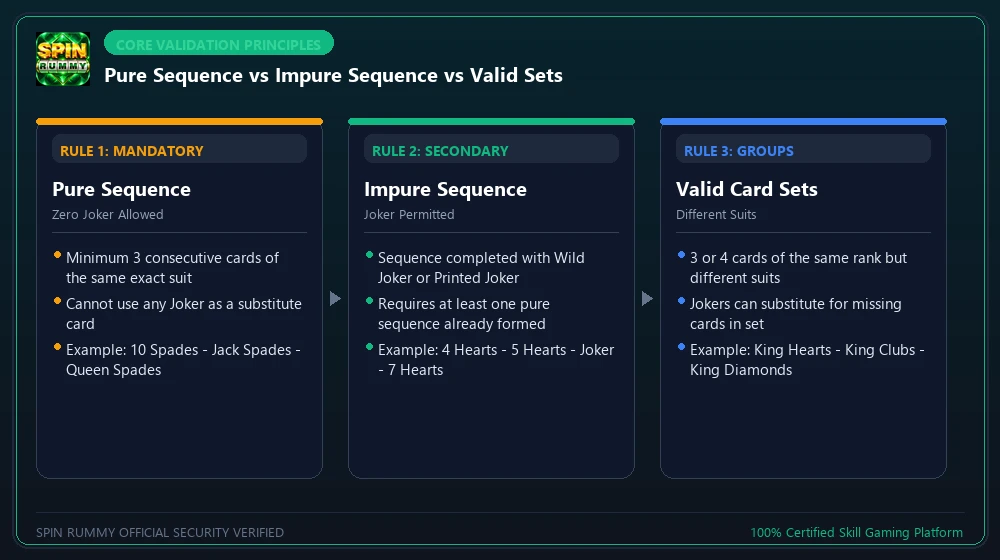
Pure Sequence: The Absolute Non-Negotiable Foundation
Forming a pure sequence in rummy is a consecutive group of three or more cards belonging to the exact same suit, formed entirely without the use of a joker (unless the joker is acting in its original natural numerical rank and suit). Under Spin Rummy Rules, creating at least one pure sequence in rummy is the absolute first legal requirement. Without a pure sequence, any declaration is categorized as a wrong show, and all remaining cards in your hand will count as full penalty points.
Examples of Valid Pure Sequences in Rummy:
Impure Sequence: Melding with Printed & Wild Cut-Jokers
An Impure Sequence is a continuous progression of three or more cards of the identical suit where one or more missing cards are substituted by a printed joker or a designated wild cut-joker. Anyone studying How to Play Spin Rummy must remember: a valid 13-card hand requires at least two sequences in total. One must be a verified pure sequence in rummy, while the second sequence can be either pure or impure.
Examples of Valid Impure Sequences:
Valid Sets: Grouping Three or Four Cards of Identical Rank
A Set in 13 card rummy consists of three or four cards of the exact same rank but belonging to different suits. A set can incorporate printed jokers and wild cut-jokers to complete the grouping. However, under Spin Rummy Rules, a set can never contain two cards of the identical suit from two separate decks—that constitutes an illegal duplicate meld.
Examples of Valid Sets:
Invalid Declarations & Disqualification Penalties (The 80-Point Wrong Show Rule)
In competitive real-money rummy, executing an invalid show (also termed a “Wrong Declaration”) carries severe punitive consequences under the Spin Rummy scoring system. If a player taps the finish button and declares an arrangement that lacks a pure sequence in rummy, contains fewer than two total sequences, or features illegal duplicated suits in a set, the platform immediately declares a Wrong Show.
Upon a Wrong Declaration, the offending player is immediately disqualified from the active hand and penalized the maximum penalty of 80 points, regardless of how many valid sets or sequences they held. In cash tables, this translates into an instant financial loss proportional to 80 points multiplied by the table stake value. One of the top Spin Rummy Winning Tips is to always double-check your pure run before declaring!
Chapter 3: Step-by-Step Mechanics: How to Play Spin Rummy Turns
Every hand of Spin Rummy follows an established turn-based cycle. Understanding the flow of drawing, evaluating, melding, and discarding allows players to execute smooth, rapid decisions under tournament time limits as they master How to Play Spin Rummy.
Step 1: Sort Your Hand in How to Play Spin Rummy
Step 1 in how to play spin rummy: As soon as the deal concludes, tap the automated “SORT” button on your interface. The app automatically groups identical suits together and alternates red and black suits to prevent visual errors. Immediately identify your wild jokers and assess whether you hold an inherent natural pure sequence in rummy.
Step 2: Draw Cards Strategically in How to Play Spin Rummy
Step 2 in how to play spin rummy: When your turn begins (signaled by a 30-second timer countdown and audio prompt), you must draw exactly one card according to Spin Rummy Rules. You can pick either the unseen top card from the face-down Closed Deck or the visible top card from the Open Discard Pile left by the player sitting immediately to your right.
Step 3: Strategic Discarding in How to Play Spin Rummy
Step 3 in how to play spin rummy: Having drawn your 14th card, you must evaluate your hand and discard exactly one unwanted card face up into the open discard pile. Drag the selected card to the discard zone or tap the card and press “DISCARD”. Your turn terminates the moment the discarded card hits the pile.
Step 4: Valid Declaration Slot in How to Play Spin Rummy
Step 4 in how to play spin rummy: Once all 13 cards are properly organized into required melds (minimum one pure sequence, minimum one second sequence, and valid remaining sets/runs), drag your 14th card into the dedicated “FINISH” slot and tap “DECLARE”. The table will pause, and a 30-second declaration verification window will open.
Step 5: Hand Validation Rules in How to Play Spin Rummy
Step 5 in how to play spin rummy: Your cards are presented face up on the table for all participants to examine. Opponents are then allotted 30 seconds to arrange their remaining cards to minimize their deadwood penalty points under the Spin Rummy scoring system. If your declaration is verified as 100% legal, you are awarded 0 points and win the table pot!
Chapter 4: Scoring System & Penalty Math in How to Play Spin Rummy
Unlike most card games where higher scores determine victory, the Spin Rummy scoring system operates under a negative scoring paradigm. The victorious player who executes a valid declaration scores 0 points. All defeated opponents accumulate penalty points based strictly on the unmelded cards (deadwood) remaining in their hands.
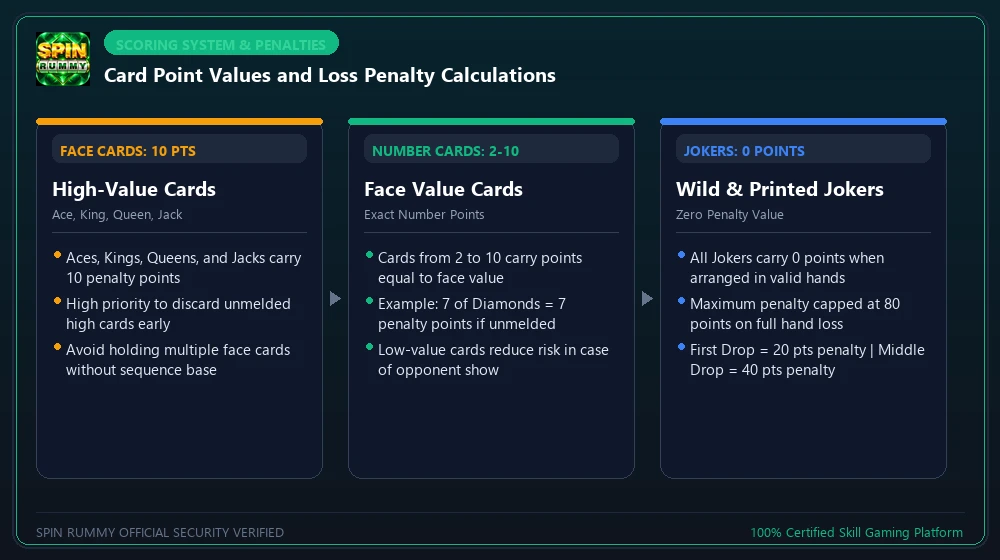
Understanding the mathematical subtleties of how to play spin rummy and its scoring system allows you to calculate risk-to-reward ratios during live table play, ensuring that even in rounds you cannot win, your point losses are strictly minimized.
Face Card & Numbered Card Point Values
| Card Classification | Specific Cards | Point Value Per Card | Strategic Risk Assessment |
|---|---|---|---|
| High-Value Face Cards | Ace (A), King (K), Queen (Q), Jack (J) of all suits | 10 Points Each | High hazard. Holding unmelded face cards inflates loss penalties rapidly under the Spin Rummy scoring system. |
| Standard Number Cards | Cards 2, 3, 4, 5, 6, 7, 8, 9, 10 of all suits | Face Value (2 to 10 Points) | Moderate hazard. Middle cards (5, 6, 7) offer superior sequence flexibility in 13 card rummy. |
| Jokers (Printed & Cut) | Printed Jokers and designated Wild Cut-Jokers | 0 Points | Zero hazard. Jokers never accumulate deadwood penalty points. |
Drop Penalties Breakdown: First Drop vs Middle Drop
When your dealt hand lacks competitive strength, exercising the strategic right to “Drop” when learning how to play spin rummy limits your financial exposure according to official Spin Rummy Rules:
- First Drop (20 Points): If you choose to fold your hand on your very first turn without drawing a single card from either deck, you concede exactly 20 penalty points.
- Middle Drop (40 Points): If you draw at least one card during the hand and later decide to drop on any subsequent turn, you incur a 40 penalty points deduction under the Spin Rummy scoring system.
- Consecutive Missed Turns (Auto-Drop): If you fail to act within the 30-second timer on three consecutive turns, the system executes an automated middle drop (40 points) to prevent table stagnation.
- Full Hand Defeat (Maximum 80 Points): If an opponent successfully declares while you hold zero valid sequences, all 13 cards in your hand are counted. However, the maximum penalty in any single deal of Points Rummy is legally capped at 80 points.
Cash Settlement Formula: How to Play Spin Rummy for Real Money
Live Table Example: Suppose you compete on a 6-player table at ₹2 per point. You declare with a valid hand (0 points). The five defeated opponents accumulate penalties of 24, 40 (Middle Drop), 18, 62, and 80 points respectively (total penalty points = 224 points). Total table pot equals 224 × ₹2 = ₹448. After deducting the platform rake (15% = ₹67.20), your net winnings of ₹380.80 are instantly credited to your wallet!
Chapter 5: 7 Proven Pro Strategies for How to Play Spin Rummy
Ascending to elite profitability in how to play spin rummy requires moving beyond basic rules into behavioral game theory and probability calculation. Deploy these 7 field-tested Spin Rummy Winning Tips to gain a decisive mathematical advantage over regular competitors across all 13 card rummy tables.
Strategy 1: Prioritize Pure Sequence in How to Play Spin Rummy
Never squander your early turns attempting to craft exotic 4-card sets. Until you lock in a verified pure sequence in rummy without jokers, your entire hand is deadwood vulnerable to an 80-point knockout. Dedicate your first 2-3 turns exclusively to constructing your pure sequence foundation.
Discard High Unmatched Cards on Turns 1 & 2
In our master guide on how to play spin rummy, holding unmatched face cards (Ace, King, Queen, Jack) hoping for a miracle connect is a rookie error. If high cards do not connect into an existing pure sequence or hold wild jokers, discard them immediately. Should an opponent declare early, unloading face cards trims your loss under the Spin Rummy scoring system from 70+ points down to under 25.
The Middle-Card Retention Rule (5, 6, 7 are Gold)
Rule #2 in how to play spin rummy: Corner cards (Ace and 2 at the bottom, King at the top) only connect in limited directions (e.g., K can only link with Q-J or A-Q). Conversely, a middle card like a 6 can combine with 4-5, 5-7, or 7-8. Retaining middle cards maximizes your probability of catching connecting cards from the closed deck in 13 card rummy.
Active Discard Pile Surveillance
A core tactical skill in how to play spin rummy is to always monitor the open pile. If an opponent sitting after you has discarded an 8♣, discarding a 9♣ or 7♣ is generally safe. One of the top Spin Rummy Winning Tips is to never feed cards that directly neighbor what your left-hand opponent has drawn from the open pile, as doing so accelerates their declaration.
Discard Baiting (Reverse Psychology Trapping)
If you hold 10♠, 10♥ and want to bait an opponent into discarding a 10♦, consider discarding a J♦ or 9♦ from a secondary holding. Opponents frequently view the suit as safe and release their matching cards directly into your waiting set! This is an essential technique when learning How to Play Spin Rummy at competitive levels.
Strategy 6: Disciplined First Drops in How to Play Spin Rummy
Rule #4 in how to play spin rummy: Grandmasters drop bad hands without emotional hesitation. A First Drop costs only 20 points under the Spin Rummy scoring system. Playing a disconnected, joker-less hand hoping for 5 consecutive lucky draws frequently results in a catastrophic 60 to 80 point loss. Dropping saves bankrolls and lets you live to conquer the next deal.
Isolate Jokers for High-Point Unmatched Melds
Rule #5 in how to play spin rummy: Do not waste a wild cut-joker on a low 2-3-4 run where the point savings are minimal. Use your jokers to complete high-value runs (such as Q-K-Joker), instantly neutralizing 30 points of deadwood in a single stroke while leaving smaller cards for flexible manual grouping across your 13 card rummy hand.
Chapter 6: Comparing Game Formats: How to Play Spin Rummy Variants
Depending on table style, how to play spin rummy varies across three primary competitive formats, each catering to distinct strategic temperaments and risk profiles under official Spin Rummy Rules:
| Format Name | Rounds / Duration | Win / Elimination Condition | Recommended Player Profile |
|---|---|---|---|
| Points Rummy | Single deal per match (2 to 3 minutes) | Winner gets 0 points; losers pay points × rupee stake | High-tempo players seeking rapid bonus unlocking & quick cash turnover in 13 card rummy. |
| 101 Pool Rummy | Multi-round elimination (15 to 25 minutes) | Players accumulating 101 points are eliminated; last standing wins pot | Strategic players who master calculated drops and defensive card retention. |
| 201 Pool Rummy | Deep multi-round tournament format (30+ minutes) | Elimination threshold set at 201 points; offers re-join options | Patient grinders who excel at long-term mathematical bankroll management. |
| Deals Rummy | Fixed 2, 3, or 6 deals per tournament | Equal chips dealt at start; player with highest chips at end wins | Tournament specialists who thrive under fixed-hand competitive parity. |
For players working through their promotional signup credits, Points Rummy provides the fastest rake-clearing velocity. To learn how table rake unlocks your ₹500 welcome bonus, review our dedicated Registration & ₹500 Welcome Bonus Guide.
Chapter 7: Beginner Mistakes to Avoid When You Learn How to Play Spin Rummy
Even talented players experience avoidable losses due to recurring cognitive oversights. Eradicating these 4 common mistakes will instantly improve your win rate as you master How to Play Spin Rummy:
- Declaring Without a Verified Pure Run: Over 40% of wrong shows occur because players build two impure sequences using jokers, forgetting that at least one pure sequence in rummy is legally non-negotiable. Double-check your suits before tapping declare!
- Telegraphing Hands via Open Pile Picks: Drawing repeatedly from the open pile shows attentive opponents exactly what cards you need, allowing them to freeze your required suits for the rest of the game. Draw from the closed deck whenever possible in 13 card rummy.
- Chasing Unviable Hands Out of Pride: Refusing to accept a 20-point First Drop because you dislike folding turns minor setbacks into full 80-point disasters under the Spin Rummy scoring system. Pride has no place at a cash rummy table.
- Ignoring Table Time Bank Limits: Allowing the turn timer to run down repeatedly triggers forced drops and forfeits your active chip contribution. Keep your attention focused entirely on the screen.
Chapter 8: Frequently Asked Questions (FAQ)
Find clear, authoritative answers to the most common questions regarding Spin Rummy Rules, scoring mechanics, and gameplay policies.
FAQ 1 Can an Ace be used in both low and high sequences in Spin Rummy?
Yes. In Indian 13 card rummy, the Ace is a versatile card that can function in a low sequence (e.g., A-2-3 of the same suit) or in a high sequence (e.g., Q-K-A of the same suit). However, an Ace cannot “round the corner” across King and 2 in a single meld (e.g., K-A-2 is strictly an invalid sequence under official Spin Rummy Rules).
FAQ 2 Under the rules of How to Play Spin Rummy, what happens if I declare without a pure sequence?
Declaring a hand without at least one valid pure sequence in rummy is a strict violation in how to play spin rummy that constitutes a Wrong Declaration. The platform will immediately disqualify your hand from the round and assess the maximum penalty cap of 80 points under the Spin Rummy scoring system, regardless of whether your remaining sets and impure sequences were correctly formed.
FAQ 3 When learning How to Play Spin Rummy, when is taking a First Drop optimal?
One of the top Spin Rummy Winning Tips is to take an immediate First Drop (20 points) if your opening hand contains zero jokers, no consecutive cards that can naturally meld into a pure sequence, and more than four isolated high-value face cards (A, K, Q, J). Conceding 20 points saves bankroll capital compared to playing a dead hand that will likely cost 60 to 80 points.
FAQ 4 Can two printed jokers be used in the same set or impure run?
Yes, provided the grouping adheres to general melding rules under Spin Rummy Rules. For example, in a 4-card impure sequence like 4♠-Joker-Joker-7♠, two jokers can legally bridge the gap. Similarly, in a set like 9♥-9♣-Joker-Joker, multiple jokers are permissible as long as you maintain your mandatory pure and second sequence elsewhere in your hand.
FAQ 5 How are wild cut-jokers determined in each game round?
Wild cut-jokers are determined automatically by the certified RNG (audited by iTech Labs) at the conclusion of the deal. One card is randomly extracted from the closed deck and turned face up under the stockpile. The numerical rank of that card becomes the wild joker across all four suits. If the extracted card happens to be a printed joker, all Aces automatically serve as wild jokers for that deal of 13 card rummy.
FAQ 6 Is rummy considered gambling or a game of skill under Indian law?
Indian rummy is judicially established as an authentic game of skill, not gambling or chance. The Supreme Court of India ruled in K. Satyanarayana (1968) and reaffirmed in KR Lakshmanan (1996) that rummy requires significant memory, card tracking, probability calculation, and strategic discarding. It is legally protected as a commercial activity under Article 19(1)(g) of the Constitution of India across the majority of Indian states. Read our complete Legality & Supreme Court Jurisprudence Dossier.
Chapter 9: Spin Rummy Sovereign Knowledge & Resource Network
Deepen your competitive mastery across the entire digital card ecosystem with our authoritative knowledge repositories:
Master Architectural Guides & Cluster Resources
The definitive 5,200+ word master compendium covering app architecture, 13-card rules, scoring math, RNG verification, and pro tournament winning strategies.
Complete technical walkthrough on downloading genuine APK v3.4.2 on Android & iOS, SHA-256 hash checks, Play Protect settings, and installation fixes.
Step-by-step mobile OTP onboarding, promo code SPIN500 redemption, paperless Aadhaar/PAN DigiLocker KYC, and 10% rake conversion rules.
Strategic breakdowns of 20+ game modes: Points, 101/201 Pool, Deals Rummy, Dragon vs Tiger, and Mines cash tables.
Step-by-step 60-second instant UPI cashout, IMPS transfers, KYC verification rules, limits, and TDS taxation math.
Official Compliance, Regulatory & Support Channels
Indian Supreme Court legal rulings, constitutional protections under Article 19(1)(g), and state-specific legal status.
Transparent financial protocols governing unutilized balance refunds, failed transactions, and game cancel settlements.
Anti-collusion mechanisms, zero-tolerance bot detection policies, and player contractual obligations.
Deposit limits, self-exclusion protocols, and player protection guidelines for a healthy gaming experience.
The technology infrastructure, corporate leadership, and player-first vision behind the Spin Rummy brand.
Direct communication channels: in-app live chat, official support email (support@spinrummy.club), and help desk ticketing.
If citing this 13-card sequence hierarchy, discard probability mathematics, or tactical tournament strategies in academic gaming studies, online forums, or digital news publications, please cite the canonical source:
Join thousands of verified players across India. Download the official Spin Rummy app, apply pro discard strategies, and win real cash with 54-second IMPS withdrawals!